WeatherCue from WeatherGuidance®

When weather says go.

History. Forecast. Action.

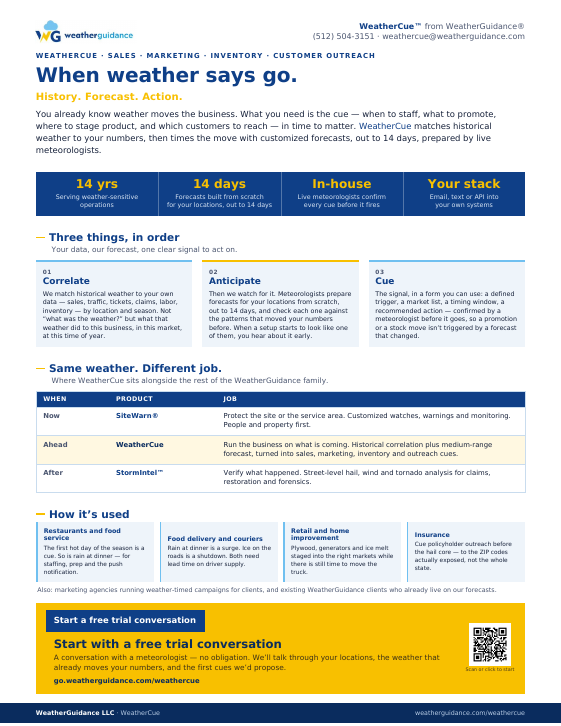
You already know weather moves the business. What you need is the cue — when to staff, what to promote, where to stage product, and which customers to reach — in time to matter. WeatherCue matches historical weather to your numbers, then times the move with customized forecasts out to 14 days, prepared by live meteorologists dedicated to your account.

Prepared by live meteorologists dedicated to your account. Fourteen years of customized forecasting for clients in all 50 states.

Cues arrive however your team works
Email
Text
API into your systems
Your meteorologist
An illustrative cue set. Each cue is a condition you define, an action you own, and a meteorologist's confirmation before it fires.
DFW · Apr 15 – May 29, last year — daily high (°F) ▮ iced-beverage sales, index 90°F May 6 · first 90° day of the season iced-beverage sales +31% vs. prior Tuesday Apr 15 May 6 May 29 Illustrative data. Your numbers, your markets, your seasons.
What correlation finds: one client's sales against the weather, and the day that moved them. Every WeatherCue program starts with a chart like this, for your numbers.

Three things, in order

Most weather vendors sell the forecast and stop. WeatherCue is built around the business action, not the atmosphere.

1

Correlate

We match historical weather to your own data — sales, traffic, tickets, claims, labor, inventory movement — by location and season. The question isn't "what was the weather?" It's "what did that weather do to this business, in this market, at this time of year?"

Your datasales · traffic · tickets · laborclaims · inventory movementby store, ZIP or marketby day and daypart · two to three years Weather, matchedtemperature · precipitation · windhail · tropical · snow and ice · heatsame locations, same days, hourly What moves your numbersFirst 90° day of the season: +31% cold drinksRain 5–8 PM: −18% dine-in, +38% deliveryHail ≥ 1.5″ within 20 mi: 74% of claimsLandfall −7d: plywood demand beginsusually two to five conditions, not twenty
What correlation is: your numbers and the weather, joined by location and day, until the handful of conditions that actually move your business fall out.

2

Anticipate

Then we watch for it. Our meteorologists, using cutting-edge forecasting technology, prepare forecasts for your locations — hourly, out to 14 days — and check each one against the patterns that moved your numbers before. When a setup starts to look like one of them, you hear about it early: which markets, which days, and how confident we are. Next Tuesday looks like last May 6. The hail setup that produced claims in these ZIP codes is back on the map for Monday night. The five-day window to move generators north opens Thursday.

That's the difference between a forecast and a cue: the forecast says 96°F; the cue says your DFW stores, Tuesday, plan for it.

DFW · 14-day outlook, prepared by your meteorologist cue window ▮ Fri84°pt cldytodaySat83°pt cldySun86°pt cldyMon89°sunTue96°sunWed97°sunThu95°sunday 7Fri90°sunSat86°pt cldySun84°pt cldyMon85°pt cldyTue88°sunWed91°sunThu90°sunday 14 Push goes out Tue 11 AM Cue: first 95°+ stretch · confirmed
The same setup, coming: a 14-day outlook with the cue window and the action date marked.

3

Cue

The signal, in a form you can use: a defined trigger, a market list, a timing window, a recommended action. Delivered through channels you already have — email, text, or API into your marketing platform, CRM or warehouse plan — and confirmed by a meteorologist before it goes, so a promotion or a stock move isn't triggered by a forecast that changed overnight. We enable the action; you own it.

The cue itself: trigger, market list, timing window, recommended action. Also by text, or by API into your tools.

How it's used

Five stories we tell most, and one for clients who already live on our forecasts. Every program is customized to your operation, so yours will look like one of these and then stop looking like it.

Restaurants, QSR and hospitality

"Last time it hit 92° the first week of May, iced-beverage sales jumped. Next Tuesday looks like that day again — here is the cue to staff, stock and push."

Historical weather correlated to sales and traffic by store and daypart. The forecast identifies the first real heat, cold, rain or patio day of the season by market. The cue can be internal — labor and inventory — or external: social, geofenced smartphone push, local media.

Cue: first day at or above 90°F in a market this season → push to app users within five miles of a store: "Great day to try our new ice-cold refreshers."

WeatherCue for restaurants and food service →

Food delivery and couriers

"Rain at dinner is a surge. Ice on the roads is a shutdown."

The opposite of a restaurant's weather problem: rain fills the order queue while thinning the driver pool. Cues to raise driver incentives before the rain reaches dinner, time promotions and ETA messaging, warn partner restaurants of the surge, and pause or resume a market ahead of ice, flooding or severe wind.

Cue: rain of a quarter inch or more during dinner hours in a market → raise driver incentives in the affected ZIPs from 4 PM and extend in-app ETA messaging.

WeatherCue for food delivery and couriers →

Mass retail and home improvement

"Plywood does not appear on the shelf the morning landfall is in the headlines."

Tropical systems, ice and heavy snow are the obvious first plays — plywood, generators, ice melt, tarps, batteries. The same logic applies to heat (fans, A/C, beverages) and to spring severe-weather seasons. The product is the timing and the market list, not the truck.

Cue: tropical system with a landfall window inside five to seven days on the Gulf coast → merchandising and logistics cue naming the stores in the cone and the day to have stock on the floor.

WeatherCue for retail and home improvement →

Insurance — proactive policyholder outreach

"Don't wait for the claim. Cue outreach to the right ZIP codes before the hail core or the tropical system."

Forecasts identify the markets and perils that matter to your book of business; historical event analysis shows which setups have actually produced loss. The cue is the outreach: who to reach, with what message, and when — email, text or push to the right policyholders, not the whole state.

Cue: large hail forecast at 60% or greater probability within 20 miles of insured properties → email and text to affected ZIP codes 24–48 hours ahead: move vehicles under cover, photograph the roof, here is the claims number.

WeatherCue for insurance →

Marketing and agencies

"Run weather-timed, geofenced campaigns for clients without building a weather desk."

Cues defined per client and per market, fed into the ad platform, push service or email tool you already use, with a meteorologist confirming the timing.

Cue: first weekend above 75°F in each of 30 markets → launch the client's patio-season creative in that market only, on that Friday.

Download the WeatherCue overview →

Any operator who already lives on our forecasts

"You already know the forecast. WeatherCue tells you what that forecast means for your sales, labor, inventory and customers."

Many SiteWarn and custom-forecast clients already ask us what the outlook means for operations. WeatherCue makes that conversation a service: scoped, repeatable, and delivered on a schedule — so weather stops being the surprise that explains last week's numbers and starts being the plan for this week's.

How a WeatherCue program is built

  1. Match history to your numbers

    You give us locations and, if you have it, sales, traffic, claims or inventory history; we match the weather to it. Together we find the conditions that matter to your business — usually two to five, not twenty. No data yet? We start with weather-only cues and add correlation as a second phase.

  2. Define the cues

    Each condition becomes a cue with a threshold, a market list, a lead time and an action owner on your side. We recommend thresholds from the history; you approve them — and you decide whether the cue is internal (staff, stock, stage) or reaches your customers.

  3. We watch, and confirm

    Meteorologists monitor the forecasts against your cues every day. When one is likely, you get an early heads-up; when it's confirmed, it fires. No cue fires on a single model run.

  4. It lands in your systems

    Email, text, or API into your marketing platform, CRM, merchandising or dispatch tools — channels you already have. Your team acts; we keep the record of what fired, where and when, so you can see what it did.

Preview of the one-page WeatherCue overview

Take the one-page overview with you

Everything on this page on a single sheet — what a cue is, the three steps, the four stories, and how a program starts. Made to forward to the people who'd own the action.

Download the PDF One page · letter size · about 70 KB

Start with a free trial conversation

Not a demo. A meteorologist and an analyst sit down with your business — your markets, your seasons, the number that moves when the weather does — and come back with the first cues we'd build for you. If it's useful, we scope a program. If not, you've lost an hour.

  • Your markets and your weather-sensitive numbers, reviewed by a meteorologist
  • The first two to five cues we'd propose, with the reasoning
  • How we'd deliver them into the tools your team already uses
  • No obligation

Pricing is built around the program, not a rate card: we will work with you to formulate an action plan that meets your needs and respects your budget.

Prefer to talk first? Call (512) 504-3151 or email weathercue@weatherguidance.com during business hours.

Tell us about your business

Takes about a minute. A meteorologist will follow up to set up the conversation.

Preferred way to reach you

No obligation. We'll only use this to prepare and follow up on your conversation.

If the weather hits the bottom line, you don't need another forecast. You need the cue.

Questions people ask

What is a weather cue?

A condition you define — the first 90-degree day of the season in a market, hail of 1.5 inches or larger forecast within 20 miles of your policyholders, a tropical system expected to make landfall within five days of a region — that we watch for and, when a meteorologist confirms it, deliver as a trigger with a market list, a timing window and a recommended action.

What do you actually deliver?

Three things: historical weather matched to your locations and dates so you can correlate it with sales, traffic or claims; customized forecasts out to 14 days by store, ZIP or market; and the cues themselves — a trigger, a market list, a timing window and a recommended action — delivered by email, text or API into your own systems.

How is this different from a weather API?

A weather API gives you data and leaves the interpretation to you. WeatherCue gives you the condition-to-action rule, tuned to your business with historical evidence, and a meteorologist who confirms a cue before it fires — so a promotion or a merchandising move isn't triggered by a forecast that changed overnight.

Do we need a data team?

It helps, but no. We'll do the historical matching and propose the cues from the evidence; your side needs someone who owns the action — the person who can approve a push campaign, a stock move or a policyholder message — and a way to receive the trigger, which can be as simple as an email.

What does it cost?

It depends on the program — how many markets, how many cues, how much correlation work, and how the cues are delivered. There is no rate card. We will work with you to formulate an action plan that meets your needs and respects your budget, starting from a free trial conversation.

Is WeatherCue a warning service?

No. SiteWarn is our warning service: it protects people, sites and territories from imminent hazards. WeatherCue is the intelligence and timing layer for the business — sales, marketing, inventory and customer outreach — including the non-severe cues a warning service would never issue: the first hot day of the season, ice in six days, stage the plywood. Same weather, different job.