
WeatherCue™ from WeatherGuidance® · Insurance: policyholder outreach
Don't wait for the claim.
This page is about one thing WeatherGuidance does for carriers — reaching policyholders before the loss. For everything else, from the StormIntel Data API to CAT maps and verification reports, see WeatherGuidance for insurance.
A hail-capable setup two days out, a hurricane four days from landfall, a flash-flood signature tomorrow night — your meteorologists can see them. What a carrier doesn't have is the discipline to turn that into outreach: which policyholders, in which ZIP codes, with what message, and when. WeatherCue is that discipline. It cues the message that moves the car under cover, gets the roof photographed, sends the prep checklist and puts the claims number in hand — before the loss, to the book that's actually in the path.
Prepared by live meteorologists dedicated to your account. Fourteen years of customized forecasting for clients in all 50 states.
Three perils, one discipline
Start with the peril that drives the most severity in your book. The cue is the outreach plan; the message and the channel are yours.
Hail
The largest avoidable-loss opportunity in most Sun Belt books: a car moved under cover is a claim that never happens. A cue 24–48 hours ahead of a hail-capable setup names the ZIP codes in the path so the message goes to the policyholders who need it, not the whole state.
Hurricanes and tropical systems
Four to five days ahead of a landfall window: the prep checklist, evacuation and shelter reminders, how and where to file, the claims number, and a pre-staging notice to the catastrophe team with the same lead time. Repeated as the cone narrows.
Flooding
Flash-flood setups arrive with the least notice and produce the most contents losses. A cue the day before — move contents up, document belongings, sandbag if available — to flood-zone and low-lying policies only.
After the event — the hand-off
When the hail core or the surge is confirmed, the same program hands the CAT team a StormIntel™ swath map for adjuster dispatch and the claims team the verification data. WeatherCue runs the before; StormIntel runs the after.
What a typical carrier program looks like
Built with policyholder experience, loss control and CAT planning. A common starting point for a regional book; national carriers repeat it by region.
- Correlate: historical event analysis against your book — which setups have actually produced loss, by peril and geography — using the same event archives behind our StormIntel work.
- Cues by peril: hail, tropical and flood, with probability thresholds, the geography of the book, lead time by peril and an owner on your side for each message.
- Lead time: 24–48 hours for hail, 4–5 days for tropical, the day before for flash flooding, and a 14-day outlook by region for CAT planning.
- Delivery: email and text to policyholder-communications and CAT leads; API into your outreach platform or CRM where the cue should land directly, with the ZIP list attached.
- Review: after each event, what fired, who was reached, and what the claims data shows — the beginning of a loss-mitigation record you can take to product and reinsurance.
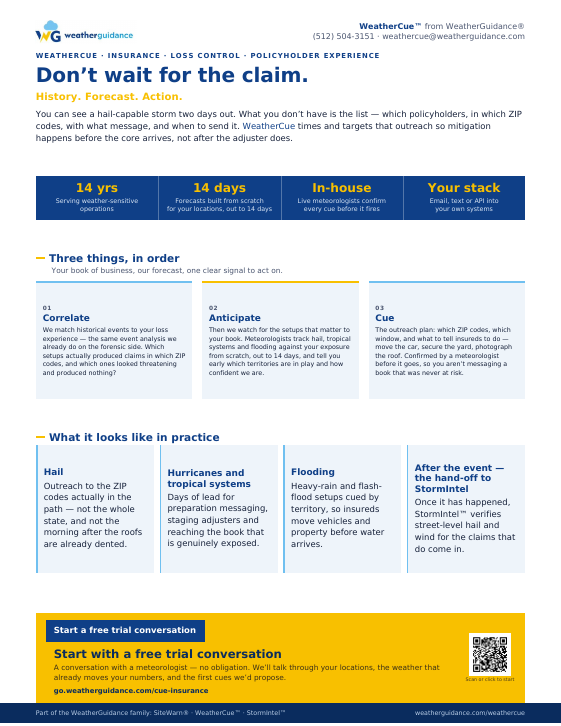
Take the one-page overview with you
Everything on this page on a single sheet — hail, hurricane and flood outreach, the hand-off to StormIntel after the event, and how a program starts. Made to forward to claims, product or catastrophe leadership.
Start with a free trial conversation
Not a demo. A meteorologist and an analyst sit down with your business — your markets, your seasons, the number that moves when the weather does — and come back with the first cues we'd build for you. If it's useful, we scope a program. If not, you've lost an hour.
- Your markets and your weather-sensitive numbers, reviewed by a meteorologist
- The first two to five cues we'd propose, with the reasoning
- How we'd deliver them into the tools your team already uses
- No obligation
Pricing is built around the program, not a rate card: we will work with you to formulate an action plan that meets your needs and respects your budget.
Prefer to talk first? Call (512) 504-3151 or email weathercue@weatherguidance.com during business hours.
If the weather hits the bottom line, you don't need another forecast. You need the cue.
Questions carriers ask
Does WeatherCue send the message to our policyholders?
You send it, through the platform you already use. WeatherCue delivers the cue — the ZIP codes or policies in the path, the peril, the window and the recommended message — and a meteorologist confirms the weather before it goes, so you're not messaging a book about hail that fell forty miles away.
How do you know which policyholders are in the path?
You give us the geography of the book — ZIP codes, or policy locations under a data agreement — and we match it to the forecast area for each cue. The cue carries the ZIP list; you carry the policy list.
How is this different from StormIntel?
StormIntel tells you what the storm did, after it, at street level, for claims and CAT dispatch. WeatherCue tells you what to do before it, for the policyholders about to be hit. Most carriers run both: the cue before, the swath map after.
Can we measure whether it reduced losses?
Yes, over time. Each cue is logged — what fired, when, who was reached — so your claims data can be compared against outreach by event. We don't guarantee loss-ratio improvement; we give you the record to measure it.
What does it cost?
It depends on the book's footprint, the perils covered and how the cues are delivered. There is no rate card; we will work with you to formulate an action plan that meets your needs and respects your budget, starting from a free trial conversation.
WeatherCue also serves restaurants and food service and mass retail and home improvement. For what the storm did after it passed, see StormIntel interactive maps. See how WeatherCue works.