
WeatherCue™ from WeatherGuidance® · Retail and home improvement
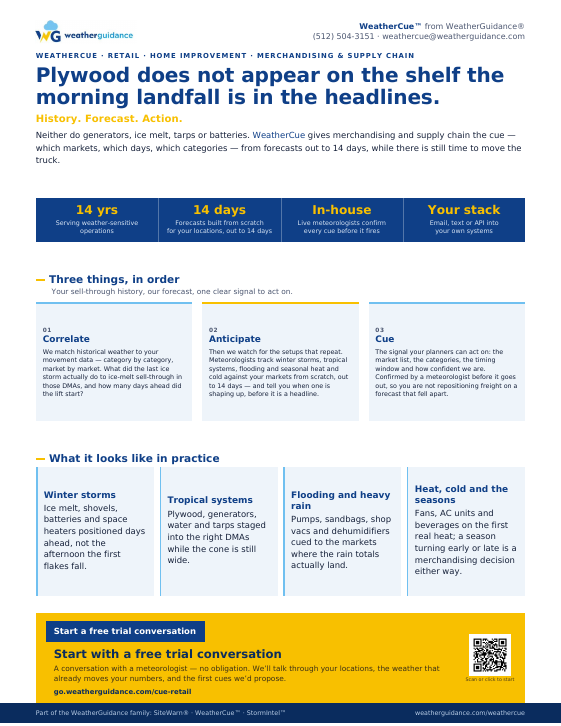
Plywood does not appear on the shelf the morning landfall is in the headlines.
You know a Gulf system means plywood and generators, an ice storm means ice melt and snow throwers, and a flood means pumps and sandbags. The question is which stores, how much, and when the trucks have to roll to be on the floor in time. WeatherCue matches what past storms did to your sales and stock by store, watches our forecasts out to 14 days for the next one, and hands merchandising and supply chain the cue: these markets, this window, this product.
Prepared by live meteorologists dedicated to your account. Fourteen years of customized forecasting for clients in all 50 states.
Four things retailers use WeatherCue for
The product is the timing and the market list, not the truck. Start with the event type that costs you the most in stockouts and markdowns.
Winter storms
Ice melt, snow throwers, shovels, heaters, pipe insulation, batteries. The cue gives allocation a 5–7 day window by market — enough to move product from a DC before the storm is a certainty and the roads are the problem.
Tropical systems
Plywood, generators, water, batteries, tarps, fuel cans, chainsaws. A cue on the landfall window names the stores in the cone and the day product must be on the floor, days before the public forecast puts the storm in the headlines.
Flooding and heavy rain
Pumps, wet/dry vacs, sandbags, dehumidifiers, sump pumps. Flash-flood setups arrive with less notice than tropical systems; a cue two to three days out is the difference between having them up front and having them in the back.
Heat, cold and the seasons
Fans and window A/C ahead of the first heat wave; heaters ahead of the first hard freeze; garden and grilling ahead of the first warm weekend. The everyday cues that move seasonal categories, market by market, on the actual weather rather than the calendar.
What a typical retail program looks like
Built with merchandising, allocation and supply chain. A common starting point for a regional footprint; national chains repeat it by region and DC.
- Correlate: two to three years of sales and inventory movement by store and category, matched to the weather events that drove them — so the cue carries a quantity, not just a direction.
- Cues by event type: winter storm, tropical, flooding, heat and cold, with thresholds, market lists and the lead time each category needs to be on the floor.
- Lead time: 5–7 days for tropical and major winter events, 2–3 days for flash flooding, and a 14-day outlook by region every morning for planning.
- Delivery: email and text to merchandising and supply chain leads; API into allocation, replenishment or e-commerce merchandising systems where the cue should land directly.
- Review: after each event, what fired, what moved, what sold and what didn't — so the next cue's quantities are better.
Take the one-page overview with you
Everything on this page on a single sheet — winter storms, tropical systems, flooding, and seasonal cues, with how the market list and window are built. Made to forward to merchandising, supply chain or regional leadership.
Start with a free trial conversation
Not a demo. A meteorologist and an analyst sit down with your business — your markets, your seasons, the number that moves when the weather does — and come back with the first cues we'd build for you. If it's useful, we scope a program. If not, you've lost an hour.
- Your markets and your weather-sensitive numbers, reviewed by a meteorologist
- The first two to five cues we'd propose, with the reasoning
- How we'd deliver them into the tools your team already uses
- No obligation
Pricing is built around the program, not a rate card: we will work with you to formulate an action plan that meets your needs and respects your budget.
Prefer to talk first? Call (512) 504-3151 or email weathercue@weatherguidance.com during business hours.
If the weather hits the bottom line, you don't need another forecast. You need the cue.
Questions merchandising and supply chain teams ask
How much earlier is this than what we already see on the news?
Days. A tropical cue on the landfall window, or a winter-storm cue on ice and snow amounts, is issued when our meteorologists are confident enough for you to move product — typically 5–7 days out — while the public forecast is still hedging. That window is what lets a truck leave the DC before demand, not after.
Do you tell us how much to move?
Where we have your sales and inventory history, yes: the cue carries a recommended quantity by store, based on what the same setup did before. Without history, the cue carries the market list and the window and your allocation team sets the quantity.
Can the cue feed our allocation or replenishment system?
Yes. Cues can be delivered by API into your own systems, or by email and text to the people who run them — whichever fits how your team works.
Does this cover e-commerce and marketing too?
Yes. The same cue that stages product in stores can feature it online and trigger the market-specific email or push — one cue, several owners.
What does it cost?
It depends on the footprint and the event types covered. There is no rate card; we will work with you to formulate an action plan that meets your needs and respects your budget, starting from a free trial conversation.
WeatherCue also serves restaurants and food service and insurance claims mitigation. See how WeatherCue works.