Shelter a campus of 5,000 only when it counts.
Sending the whole campus to the stairwells for an NWS warning that never arrives costs an afternoon of productivity and a little more credibility every time. SiteWarn™ monitors your exact campus 24/7/365 and gives security and facilities a warning with real arrival timing when a storm is actually coming — and a null-warning notification when it isn't — plus winter-weather calls days ahead for closures and remote-work decisions.
Trusted for 14 years at more than 400 sites in all 50 states, with a 100% client renewal rate.
Customized for a single site — or for a command or operations center monitoring hundreds, even thousands, of sites from one screen.
Why corporate campuses choose SiteWarn
A fully customized program: you set the thresholds, we watch the weather.
Your campus, not the entire region
Instead of an oversized warning covering thousands of square miles, we monitor your exact campus and warn only when there's a real threat to your buildings, with expected arrival time. When an NWS polygon includes your site but the storm won't reach you, a null-warning notification tells security so — and 5,000 people stay at their desks.
Lightning for the people outside
The National Weather Service issues no warning for cloud-to-ground lightning. Grounds crews, the loading dock, the campus shuttle stop, the outdoor cafeteria and the company softball field are all exposed; we warn facilities and security in time to bring people in.
Closure and remote-work calls days ahead
Winter storms, ice and large-scale wind events are warned days out, not hours — watches up to 7 days ahead, warnings by day 5, with onset and end timing — so HR and facilities can make the closure or work-from-home call the day before instead of the morning of.
Every office in the portfolio
A headquarters, three regional offices and a distribution center rarely face the same weather at once. Multi-site programs cover each with its own thresholds and contacts on a group rate, with unlimited users and delivery through the portal, app, phone, text, email or API into your mass-notification platform.
What a typical campus program looks like
Every program is built with corporate security and facilities. Here is a common starting point for a headquarters campus; multi-site employers repeat it per location.
- Tornado and severe thunderstorm: campus-specific warnings with expected arrival time at your shelter-in-place lead time (commonly 20–30 minutes for an office campus); null-warning notification when the NWS polygon includes you but the storm does not.
- Lightning: alert on cloud-to-ground strikes within 10 miles for grounds and dock crews, warning within 5 miles for anyone outdoors, all-clear 30 minutes after the last strike inside the radius.
- High wind and hail: warnings at your thresholds — for example, gusts above 50 mph for rooftop equipment and parking structures, any hail over 1 inch for the employee parking lot — with onset and end timing.
- Winter weather and large-scale events: watches days ahead and warnings by day 5 for ice, heavy snow and major wind events, with timing for closure and remote-work decisions; flash-flood warnings for the campus and access routes.
- Delivery: portal and push alerts to security and facilities, live phone call to the on-duty security supervisor for anything life-safety, text and email to business continuity and workplace leadership — and an API feed into your mass-notification platform so shelter and closure messages go out through channels employees already know.
- Heat (WBGT or heat index): advisories and warnings at your activity or work-rest thresholds on either scale — WBGT by default for outdoor crews and athletics — per site.
- Wildfire: advisory when fire-weather conditions are expected to threaten the site or its access routes; warning when an active fire's location and expected spread put the site at risk, with timing and an all-clear.
- Hazard Matrix for the security operations center: your campuses and offices grouped into regions you define, with each region's status for every hazard on one grid, so corporate security reads the portfolio at once.
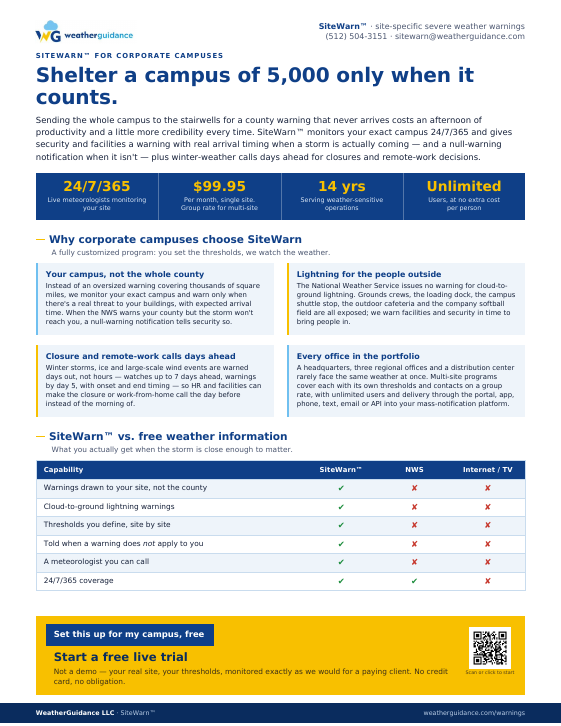
Take the one-page overview with you
Everything on this page on a single sheet — campus-specific tornado warnings, fewer needless shelter orders, closure calls days ahead, and how to start a Free Live Trial. Made to forward to your security director or business continuity lead.
"I am very impressed with how SiteWarn has allowed us to keep employees safe and avoid un-needed weather related shutdowns at the same time. The service has paid for itself time and again."
SABIC Plant Safety and Security, Ottawa, IL
"You were forecasting 3–4 inches of snow when the local people were only forecasting 1. We got almost 4 inches just like you said, and were prepared thanks to you."
Mark, HealthEast Care System, Minneapolis–St. Paul, MN
Questions corporate security and facilities teams ask
How does this reduce unnecessary shelter-in-place orders?
Because warnings are drawn to your campus with expected arrival time, and because you receive a null-warning notification when an NWS warning doesn't reach you, security issues shelter orders when a storm is actually coming — which is a small fraction of the NWS warnings your campus sits inside.
Can SiteWarn feed our mass-notification system?
Yes. Warnings go to your security and continuity teams through the portal, app, phone, text and email, and can be pushed into your mass-notification platform by API so shelter and closure messages go out through the channels employees already use.
Can one program cover our headquarters and regional offices?
Yes. Multi-site programs cover every location with per-site thresholds and contacts on a group rate, in all 50 states. Single-site programs start at $99.95 a month; multi-site discounts apply — ten sites does not cost ten times one.
How far ahead do you warn on winter weather?
Winter storms, ice and large-scale wind events are issued as watches up to 7 days ahead and converted to warnings by 5 days out, with onset and end timing, so closure and remote-work decisions can be made the day before.
What does the Free Live Trial involve?
We set up your real campus, thresholds and delivery methods and monitor them exactly as we would for a paying client — no credit card and no obligation. Most sites are live the same day; overnight requests are set up the next morning.
See it live before the next NWS warning
Not a demo. We set up your real campus with your real thresholds and contacts and monitor it exactly as we would for a paying client.
- Site forecasts and live tornado, lightning, wind and winter weather warnings for your actual campus
- Portal, app and radar access for security, facilities and business continuity — API available for mass-notification integration
- Your thresholds, lead time and delivery methods
- No credit card, no contract, no obligation
Prefer to talk first? Call (512) 504-3151 or email sitewarn@weatherguidance.com during business hours, and we'll get right back to you.
SiteWarn also serves data centers, hospitals and healthcare, manufacturing plants and more than a dozen other industries. See what the portal and app look like.