Move critical patients before the storm, not during.
Relocating ICU and NICU patients, securing the helipad and briefing clinical staff takes time an NWS warning doesn't give you. SiteWarn™ monitors your exact campus 24/7/365 and warns emergency management with the lead time you set — and tells you when a warning on the news doesn't reach your buildings, so you only mobilize when you actually need to.
Trusted for 14 years at more than 400 sites in all 50 states, with a 100% client renewal rate.
Customized for a single site — or for a command or operations center monitoring hundreds, even thousands, of sites from one screen.
Why healthcare facilities choose SiteWarn
A fully customized program: you set the thresholds, we watch the weather.
Move critical patients before the storm
Advance warning on inbound severe weather gives your team time to relocate ICU, NICU and dialysis patients to interior safe areas, secure rooftop helipad operations and brief clinical staff — before, not during, the event. You set the lead time; we work back from it.
Your campus, not the entire region
Instead of an oversized warning covering thousands of square miles, we monitor your exact campus and alert only when there's a real threat — so you only mobilize when you actually need to, and staff keep trusting the alert when it comes.
Pre-activate generators and supplies
Advance notice lets facilities verify backup power, top off fuel, secure exterior equipment and pre-stage emergency supplies before damage starts — protecting continuity of care when minutes matter. Large-scale wind and ice events are warned days out.
Alerts your way, unlimited users
Portal, app, email, text or push, phone (live or recorded) — or into your mass-notification or incident-command system by API — to emergency management, facilities, security and clinical leadership. Interactive radar with your campus mapped, at no extra cost per user.
What a typical hospital program looks like
Every program is built with your emergency manager. Here is a common starting point for a single campus; health systems repeat it per facility, including clinics and senior living.
- Tornado and severe thunderstorm: campus-specific warnings with expected arrival time, issued at your patient-relocation lead time (commonly 30–45 minutes) when the campus is in the storm's path; null-warning notification when the NWS polygon includes you but the storm does not.
- Lightning: alert on cloud-to-ground strikes within 10 miles (helipad and outdoor operations), warning within 5 miles, all-clear 30 minutes after the last strike inside the radius.
- High wind and hail: warnings at your thresholds — for example, gusts above 45 mph for helipad operations and rooftop equipment, any hail for exposed vehicles and ambulances — with onset and end timing.
- Winter weather, flooding and large-scale events: watches days ahead and warnings by day 5 for ice, heavy snow and major wind events, with timing for staffing, supply and generator decisions; flash-flood warnings for the campus and access routes.
- Delivery: portal and push alerts to emergency management and the house supervisor, live phone call to the on-duty administrator for anything patient-critical, text and email to facilities, security and nursing leadership — and an API feed into your mass-notification or incident-command platform.
- Heat (WBGT or heat index): advisories and warnings at your thresholds for outdoor staff, patient transport and campus events, on either scale.
- Wildfire: advisory when fire-weather conditions are expected to threaten the site or its access routes; warning when an active fire's location and expected spread put the site at risk, with timing and an all-clear.
- Hazard Matrix for the health system: your facilities grouped into regions you define — hospitals, clinics and senior living by market — with each group's status for every hazard on one grid, for the system's emergency operations center.
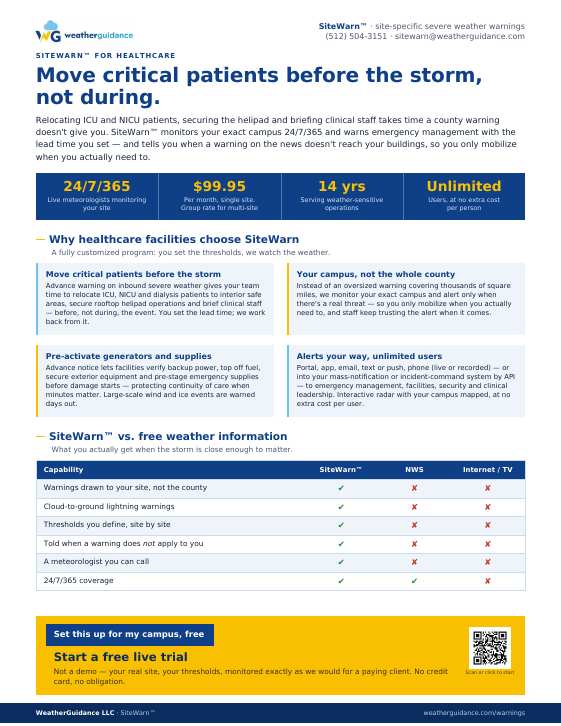
Take the one-page overview with you
Everything on this page on a single sheet — patient relocation lead time, campus-specific warnings, generator pre-activation, and how to start a Free Live Trial. Made to forward to your emergency manager or facilities director.
"You were forecasting 3–4 inches of snow when the local people were only forecasting 1. We got almost 4 inches just like you said, and were prepared thanks to you."
Mark, HealthEast Care System, Minneapolis–St. Paul, MN
"Your service is invaluable not only for student and campus safety but for our day in, day out operations as well."
Rod Walls, Hays Consolidated ISD, Kyle, TX
Questions hospital emergency managers ask
How much lead time can you give us to relocate patients?
Lead time is part of your custom program. Most hospitals choose 30 to 45 minutes for tornado and severe thunderstorm warnings, matched to how long patient relocation and helipad securing take; longer lead time means earlier, slightly less certain warnings, and we help you find the balance.
Does this support our Joint Commission emergency management requirements?
SiteWarn provides documented, site-specific hazard warnings and a meteorologist available 24/7/365, which many facilities reference in their hazard vulnerability analysis and emergency operations plan. Warning records are retained in the portal.
Can one program cover a health system with hospitals, clinics and senior living?
Yes. Multi-site programs cover every facility with per-site thresholds and a group rate, and deliver warnings to unlimited staff. Single-site programs start at $99.95 a month; multi-site discounts apply — ten sites does not cost ten times one.
Do you warn for lightning?
Yes. The National Weather Service issues no warnings for cloud-to-ground lightning. SiteWarn alerts you to strikes within a custom radius of your site with enough lead time to move people and protect equipment, and tells you when it is safe to resume.
What does the Free Live Trial involve?
We set up your real campus, thresholds and delivery methods and monitor them exactly as we would for a paying client — no credit card and no obligation. Most sites are live the same day; overnight requests are set up the next morning.
See it live before the next severe weather season
Not a demo. We set up your real campus with your real thresholds and contacts and monitor it exactly as we would for a paying facility.
- Site forecasts and live tornado, lightning, wind and winter weather warnings for your actual campus
- Portal, app and radar access for emergency management, facilities and security — API available for mass-notification integration
- Your thresholds, lead time and delivery methods
- No credit card, no contract, no obligation
Prefer to talk first? Call (512) 504-3151 or email sitewarn@weatherguidance.com during business hours, and we'll get right back to you.
SiteWarn also serves universities, school districts, corporate campuses and more than a dozen other industries. See what the portal and app look like.