
Weather warnings for the segment, not the whole network.
An NWS warning tells dispatch nothing about which trucks are actually driving into it. SiteWarn™ maps your lanes as corridors and your terminals and DCs as points, and live meteorologists watch all of it 24/7/365 — warning you about the stretch of road, the yard and the time window that are really in the storm's path. And because a network plans days ahead, so do we: a 7-day outlook on every lane, and high-wind and winter-storm warnings issued days out, not hours.
Trusted for 14 years at more than 400 sites in all 50 states, with a 100% client renewal rate.
Customized for a single site — or for a command or operations center monitoring hundreds, even thousands, of sites from one screen.
Why fleets and distribution networks choose SiteWarn
A fully customized program: you set the thresholds, we watch the weather along every lane and at every yard.
Corridors and terminals, not regions
We load your routes as buffered corridors — a few miles either side of the centerline — and your terminals, DCs and yards as points. A warning names the segment, the mile range and the time window, so dispatch holds the two loads headed into it and the rest of the network keeps rolling.
Lead time measured in days, not minutes
Planners, load builders and driver managers can't work off a 60-minute warning. Every lane and terminal gets a 7-day planning outlook — 10 days when your planning cycle needs it — and large-scale high-wind, winter-storm and flooding events go out as watches up to 7 days ahead, converted to warnings by day 5. Short-fuse thunderstorm hazards still get 60 minutes or more.
Wind warnings built for high-profile equipment
Rollover and jackknife risk starts well below the gust speeds the NWS warns on. You set the crosswind threshold for your trailers. Synoptic wind events — the pressure gradients behind a strong front or a mountain-wave setup — are warned days ahead by corridor; thunderstorm outflow and gap winds are warned an hour or more ahead of the segment, timed to where your trucks will be, not where they are.
Yards, docks and DCs covered too
Lightning at the dock, hail on the yard, ice on the ramps and flooding at the gate are site problems, and we cover them the same way we cover any facility — with thresholds per location and null-warning notifications when an NWS warning doesn't reach your yard.
What a typical network program looks like
Every program is built with your safety and dispatch leads. Here is a common starting point for a regional carrier with a handful of lanes and terminals; national networks repeat it lane by lane.
- 7-day planning outlook, every lane and terminal: issued daily, covering wind, winter weather, flooding and severe-weather potential by corridor and day — extendable to 10 days for networks that plan further out.
- Large-scale high wind (storm-system driven): watch issued up to 7 days ahead for the corridors and days affected, converted to a warning by 5 days out with expected onset, peak and end times by segment, at your equipment threshold — for example, 40 mph crosswind for dry vans.
- Thunderstorm wind, hail and tornado on a corridor: segment-specific warnings with the affected mile range and time window, issued 60 minutes or more ahead; null-warning notification when an NWS warning covers a lane but the storm won't reach it.
- Flooding: river-flood and heavy-rain outlooks days ahead for lanes that cross known problem areas, plus short-fuse flash-flood warnings for corridor segments and specific low-water crossings.
- Winter weather: watches up to 7 days ahead and warnings by 5 days out for ice, heavy snow and blowing snow by segment and mountain pass, with onset and end timing — updated in real time as chain requirements and closures develop.
- Terminals and DCs: lightning alerts for dock and yard crews (within 10 miles, warning within 5), hail and high-wind warnings for the yard, and winter-weather timing for shift and gate decisions.
- Wildfire: advisory when fire-weather conditions are expected to threaten the site or its access routes; warning when an active fire's location and expected spread put the site at risk, with timing and an all-clear.
- Heat (WBGT or heat index): advisories and warnings at your work-rest thresholds for yard and dock crews, on either scale.
- Hazard Matrix for the operations center: your terminals, DCs and lane segments grouped into regions you define, with each region's status for every hazard on one grid, for dispatch and safety leadership.
- Delivery: portal and push alerts for dispatch and the operations center, live phone call to the on-duty safety lead for anything driver-critical, app or text to drivers and terminal managers — and an API feed into your TMS, dispatch or in-cab platform so corridor warnings show up where your planners already work.
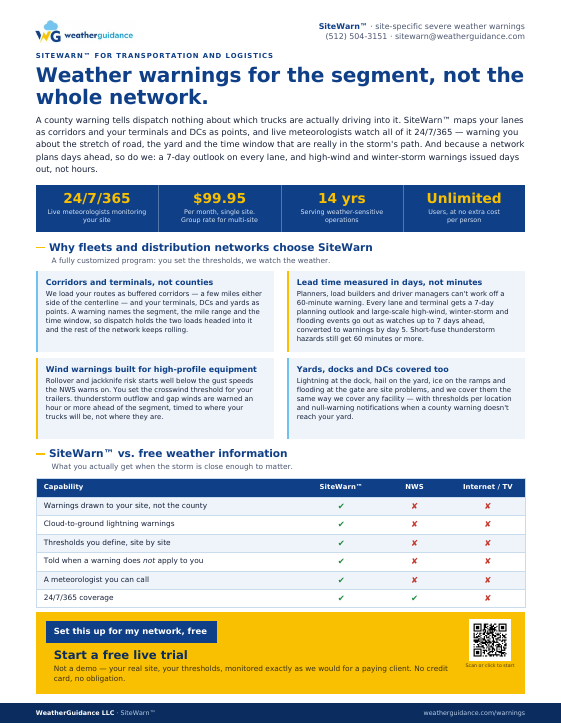
Take the one-page overview with you
Everything on this page on a single sheet — corridor warnings by segment, 7-day planning lead, high-wind warnings for high-profile equipment, and how to start a Free Live Trial. Made to forward to your safety director or VP of operations.
"I am very impressed with how SiteWarn has allowed us to keep employees safe and avoid un-needed weather related shutdowns at the same time. The service has paid for itself time and again."
SABIC Plant Safety and Security, Ottawa, IL
"You were forecasting 3–4 inches of snow when the local people were only forecasting 1. We got almost 4 inches just like you said, and were prepared thanks to you."
Mark, HealthEast Care System, Minneapolis–St. Paul, MN
Questions fleet and logistics operators ask
Can you warn on a route instead of a single address?
Yes. We map each lane as a buffered corridor and each terminal or DC as a point. A warning names the segment, the mile range and the time window in a storm's path — not a whole route or region — so dispatch can act on exactly the loads affected.
How far ahead do you warn?
Every lane and terminal gets a 7-day planning outlook, extendable to 10 days. Large-scale high-wind, winter-storm and flooding events are issued as watches up to 7 days out and converted to warnings by 5 days out, with onset and end timing by segment. Thunderstorm-driven hazards — hail, tornadoes, outflow wind — are warned 60 minutes or more ahead of the affected segment.
Do you warn on high wind for high-profile vehicles?
Yes. You set the crosswind or gust threshold for your equipment. For storm-system wind events we issue watches up to 7 days ahead and warnings by day 5 for the affected corridors; for thunderstorm outflow, gap and downslope winds we warn an hour or more ahead of the segment. The NWS may not warn on any of these at your threshold.
How do drivers get the warning?
However you want them to. Most fleets take corridor warnings into dispatch on the portal and by push alert and relay to drivers through their existing in-cab system; others send app or text alerts straight to drivers; and fleets with a TMS or in-cab platform can pull warnings in directly through the SiteWarn API. Anything driver-critical can also trigger a live phone call to your on-duty safety lead.
Can one program cover a multi-state network?
Yes. We monitor client operations in all 50 states. A network program covers every lane, terminal and DC with per-location thresholds and a group rate; single-site programs start at $99.95 a month; multi-site discounts apply — ten sites does not cost ten times one.
What does the Free Live Trial involve?
Send us your lanes (a route file, a list of highways and endpoints, or even a screenshot of your map) and your terminals. We build the corridors, set thresholds with your safety lead, and monitor and warn exactly as we would for a paying client — no credit card and no obligation.
See it live on your own lanes
Not a demo. We load your real lanes and terminals with your real thresholds and monitor them exactly as we would for a paying client.
- 7-day outlooks and live corridor and terminal warnings for your actual network
- Your thresholds, lead time and delivery methods
- Portal and radar with your lanes and yards mapped, for dispatch and safety — API available for integration
- No credit card, no contract, no obligation
Prefer to talk first? Call (512) 504-3151 or email sitewarn@weatherguidance.com during business hours, and we'll get right back to you.
SiteWarn also serves railroads, corporate campuses, manufacturing plants and more than a dozen other industries. See what the portal and app look like.